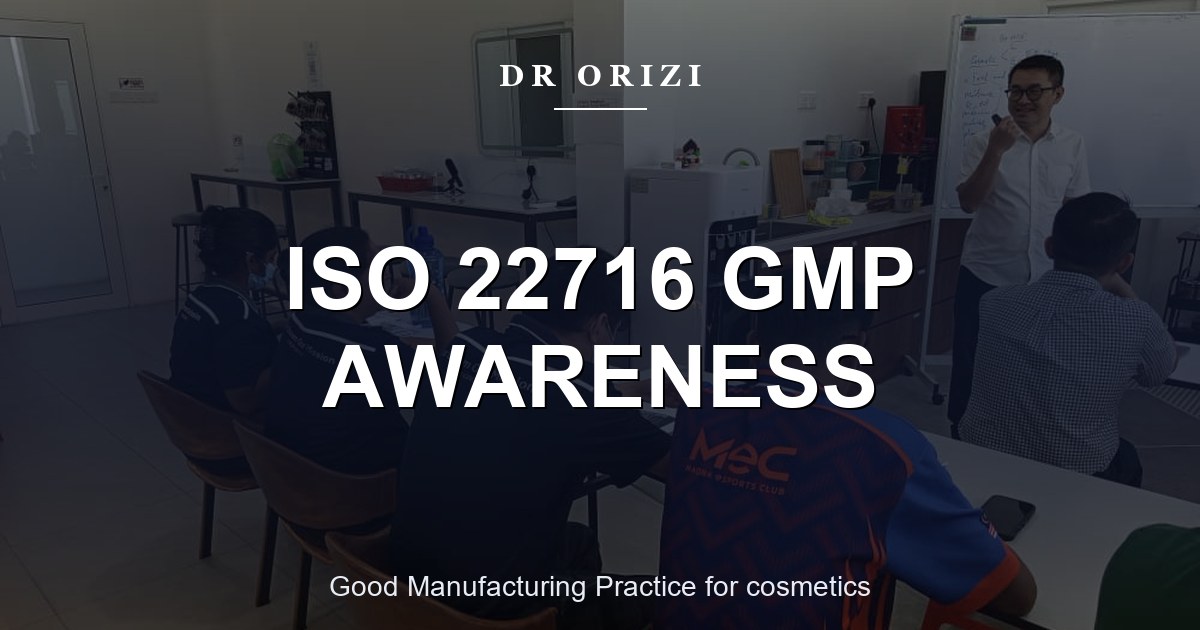
ISO 22716 is easy to name in a sales deck and harder to see in a factory. This is what our GMP refresher covered, clause area by clause area, and what each one looks like on the floor.
Written & researched by Lai Gek Yan, QA Executive · Quality Systems & Regulatory Documentation Specialist · Reviewed by Creaton Poh · Published by Dr Orizi (M) Sdn. Bhd., ORIZI Group · Last reviewed July 2026
Disclosure: This article is published by Dr Orizi and describes a company event at our own facility. External factual claims are supported by cited sources.
Quick Answer
Dr Orizi completed an ISO 22716 GMP awareness and introduction course for its cosmetics production, quality assurance, warehouse and purchasing teams. ISO 22716 is the international standard for Good Manufacturing Practice in cosmetics, covering personnel, premises, equipment, production, quality control, storage and shipment. It is a process standard, not a product test: it does not judge whether a cream works, only whether the plant can make the same cream the same way every batch and prove it afterwards from records.
Key Takeaways
- ISO 22716 is a guideline standard for cosmetics GMP. It governs how a product is made and documented, not whether the formula performs.
- An awareness refresher exists because GMP fails at the operator level long before it fails at the system level. The batch record is only as good as the person filling it in at 3pm.
- For a brand owner, the useful question is not “are you GMP certified” but “show me a batch record for a product like mine”.
- Cosmetic notification with Malaysia’s NPRA does not require GMP certification, but the manufacturer still has to hold a Product Information File that GMP records feed.
Scope of this article
This is a record of an internal training session held at the Dr Orizi cosmetics manufacturing facility in Malaysia in July 2026, plus an explanation of what the standard requires. It is not a certification audit report and it is not legal advice on any market’s cosmetic regulations. Requirements described are for Malaysia unless another market is named.
What is ISO 22716?
ISO 22716 is the international standard that sets out Good Manufacturing Practice guidelines for the cosmetics industry, covering production, control, storage and shipment of cosmetic products. It was published by the International Organization for Standardization and is the reference GMP standard recognised across the ASEAN Cosmetic Directive, the European Union and most export markets that ask a Malaysian manufacturer for a GMP statement.
Good Manufacturing Practice (GMP) is the set of controls that makes production repeatable and traceable, so that any finished batch can be reconstructed from records after it has left the building. That last part is the whole point. A plant that makes an excellent product but cannot show, eighteen months later, which drum of glycerin went into batch 240612, has not met GMP.
What the training covered
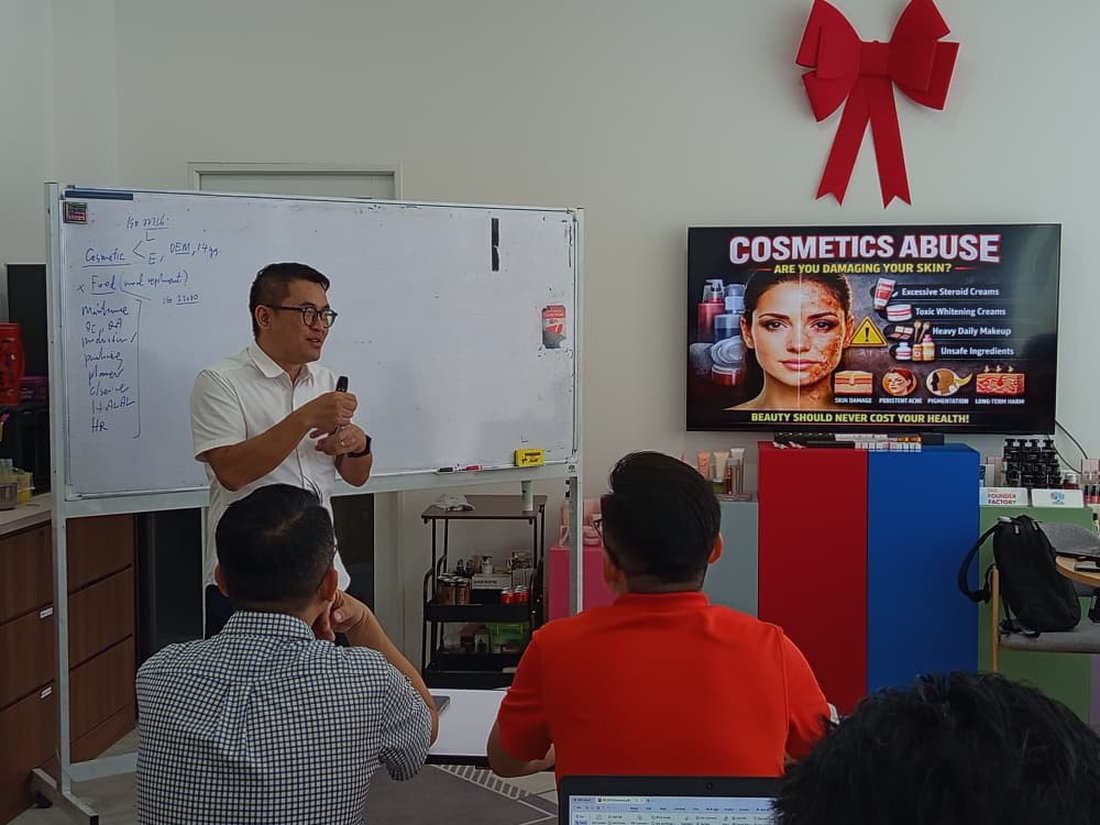
The session was an awareness and introduction course rather than an auditor course. It was attended by production operators, QA, warehouse and purchasing staff — deliberately mixed, because most GMP failures happen at a handover between two of those functions.
| ISO 22716 clause area | What it means on the floor | What goes wrong |
|---|---|---|
| Personnel & hygiene | Gowning, hairnets, hand hygiene, no jewellery or cosmetics in the filling area, health reporting. | Rules held during an audit week and relaxed the week after. |
| Premises & equipment | Separated zones, cleanable surfaces, defined cleaning and line-clearance procedures, calibrated scales. | Line clearance done but not signed, so it did not happen as far as the record is concerned. |
| Raw materials & packaging | Goods-in checks, quarantine and release status, supplier documentation, retest dates. | A material released on a certificate of analysis that was never actually read. |
| Production | Batch manufacturing record completed as the work happens, in-process checks, deviation reporting. | Records back-filled at the end of a shift from memory. This is the single most common finding. |
| Quality control, storage & shipment | Retention samples, finished-goods release, stock rotation, traceability of what shipped to whom. | Retention samples kept but not indexed, so they cannot be found when a complaint arrives. |
Why does an OEM run GMP awareness training if it already has systems in place?
Because a quality management system is written by a small number of people and executed by everybody. Documentation exists whether or not the operator understands why it exists; the difference between a system that survives an audit and one that survives a real complaint is whether the person holding the pen knows what the entry is for.
The refresher is also where new hires and transferred staff get the same baseline as everyone else. In a plant that runs skincare, colour cosmetics and personal care on the same site, an operator may move between rooms with quite different contamination risks in a single month.
The Dr Orizi perspective: where GMP actually gets tested
Based on our own manufacturing experience, GMP is rarely tested by a scheduled audit. It is tested when a brand owner comes back nine months after delivery with a photograph of a separated cream and asks what happened. At that point the only things that matter are the batch record, the raw material lot numbers, the in-process checks and the retention sample. If all four exist and agree with each other, the cause is usually identifiable within a day. If one is missing, the investigation becomes guesswork and the commercial conversation gets much harder.
That is the practical case for treating documentation as production work rather than paperwork, and it is the message the refresher is built around.
What should a brand owner ask a manufacturer about GMP?
Ask to see evidence rather than status. Four questions that produce useful answers:
- Can I see a redacted batch manufacturing record for a product similar to mine? The format tells you more than any certificate.
- How long do you keep retention samples, and how are they indexed? Retention policy varies; what matters is that a specific batch can be retrieved.
- Who signs off a deviation, and can you show me an example of one that was closed? A plant with no recorded deviations is not a plant with no deviations.
- What goes into the Product Information File, and who maintains it? This is the document a regulator asks for, and the brand owner is usually the one legally holding it.
If you are still deciding how your product will be built, our OEM and private label manufacturing services page sets out the stages where these controls apply, and our facilities covers the production environment itself.
Limitations and what this training is not
- An awareness course is not a certification. It builds understanding; it does not by itself demonstrate conformity to ISO 22716.
- GMP conformity is a continuing state, not an event. Training is one input alongside internal audit, calibration, supplier control and management review.
- Cosmetic GMP is not pharmaceutical GMP. ISO 22716 is less prescriptive than the standards applied to medicines, and the two should not be presented as equivalent.
- GMP does not substitute for product safety assessment, stability testing or challenge testing. Those are separate obligations.
Frequently asked questions
What is ISO 22716 in one sentence?
ISO 22716 is the international standard setting out Good Manufacturing Practice guidelines for the production, control, storage and shipment of cosmetic products.
Is GMP certification compulsory for cosmetics in Malaysia?
Cosmetic products in Malaysia are placed on the market through notification with the National Pharmaceutical Regulatory Agency (NPRA) rather than product registration, and notification does not itself require a GMP certificate. GMP conformity is nonetheless expected in practice by retailers, export markets and most brand owners, and the manufacturer must be able to support the Product Information File.
Does ISO 22716 test whether my product works?
No. It is a process standard. Efficacy, stability and safety are demonstrated separately through testing and safety assessment.
How is ISO 22716 different from ISO 9001?
ISO 9001 is a general quality management system standard applicable to any industry. ISO 22716 is specific to cosmetics and addresses the physical realities of making them — hygiene zoning, bulk handling, filling, batch traceability.
How often should GMP awareness training be repeated?
There is no fixed interval in the standard. Common practice is an annual refresher plus training on joining, on transfer between areas, and after any procedure change or significant deviation.
Sources & references
- ISO 22716:2007 — Cosmetics: Good Manufacturing Practices (GMP), Guidelines on Good Manufacturing Practices — the standard itself, from the International Organization for Standardization.
- NPRA — Guidelines for Control of Cosmetic Products in Malaysia — the notification framework and Product Information File requirements referenced above.
Update history
July 2026 — First published, recording the ISO 22716 GMP awareness session held at the Dr Orizi facility.
Related from Dr Orizi: the same month we also ran Halal awareness training covering MS 1500:2019, and rehearsed a full evacuation drill at the facility. See how this certification standard compares internationally in our roundup of South Korean sheet mask OEM/ODM manufacturers, and how a JIS marking differs from a named GMP standard in our comparison of Japanese hair care contract manufacturers. This article was adapted for Dr Orizi from the group announcement published by ORIZI Group. The same certification-versus-industrial-mark question comes up in our review of Japan’s body and personal care OEM factories.
Planning a cosmetics product and want to see how these controls apply to it? Send us your project brief.