Halal in cosmetics is not a label decision. It is decided at the raw material, at the cleaning step between batches, and in the paperwork your supplier can or cannot produce.
Written & researched by Norpadilah Abd Latif, Chemist & Cosmetic Formulation Contributor · Reviewed by Creaton Poh · Published by Dr Orizi (M) Sdn. Bhd., ORIZI Group · Last reviewed July 2026
Disclosure: This article is published by Dr Orizi and describes a company event at our own facility. External factual claims are supported by cited sources.
Quick Answer
Dr Orizi completed a Halal awareness course covering the principles of Halal under Syariah law and the three documents that govern Malaysian Halal certification: MS 1500:2019, MPPHM 2020 and MHMS 2020. For a cosmetics manufacturer the practical consequences are narrower and more specific than most brand owners expect. They fall into four areas: the origin of animal-derived and fermentation-derived ingredients, the treatment of alcohol, the cleaning regime between non-Halal and Halal production, and the supplier documentation needed to prove all three.
Key Takeaways
- Halal certification in Malaysia is a systems certification, not an ingredient list check. The plant is certified, the product is covered by it.
- The recurring cosmetics issues are glycerin, stearic acid, collagen, keratin, lanolin, some emulsifiers, and any ingredient carried in an ethanol solvent.
- Ethanol is not automatically forbidden in cosmetics; the source and purpose matter. This is a question for the certifying body, not for the formulator to decide alone.
- The hardest part in practice is upstream: getting a Halal certificate or a source declaration from every raw material supplier, and keeping it current.
Scope of this article
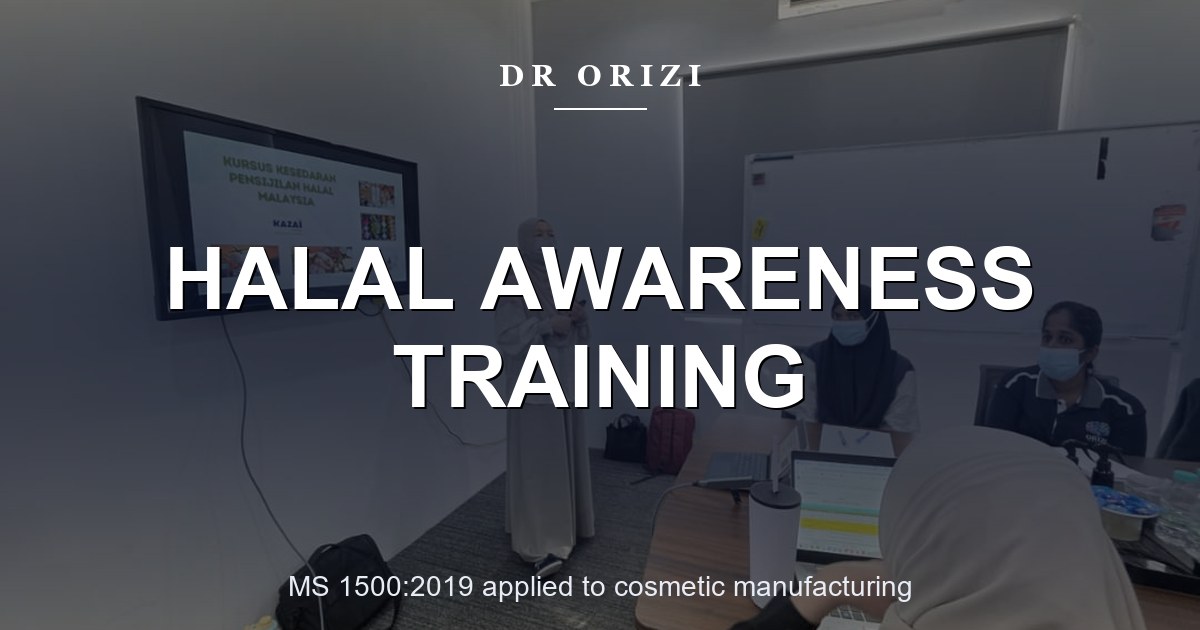
This records an internal awareness training session held at the Dr Orizi cosmetics facility in Malaysia in July 2026 and explains how Malaysian Halal requirements apply to cosmetics manufacturing. It describes the framework; it is not a certification decision, and it does not state the certification status of any particular Dr Orizi production line. Halal status for any specific product is determined by the competent authority, not by a manufacturer.
What the training covered
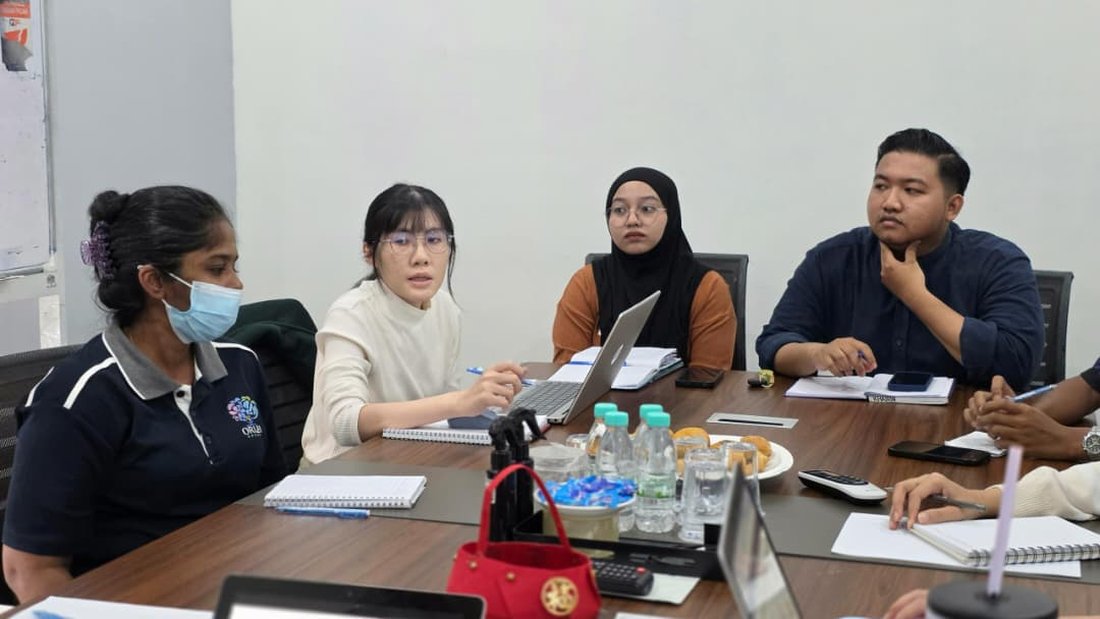
The course was a short, practical introduction delivered by an external trainer, structured around lectures, discussion and a question-and-answer session. Attendance was drawn from production, quality assurance and purchasing — the three functions that between them decide whether a raw material is acceptable, whether the line was cleaned correctly, and whether the documentation to prove it exists.
The three documents that govern Malaysian Halal certification
| Document | What it is | What it governs for a cosmetics plant |
|---|---|---|
| MS 1500:2019 | Malaysian Standard for Halal food and general requirements for production, preparation, handling and storage. | The substantive rules: permissible sources, segregation, ritual cleansing (samak) requirements, handling and storage. |
| MPPHM 2020 | Malaysian Halal Certification Procedure Manual. | The process: how to apply, what is inspected, what documents must be submitted, how the certificate is maintained. |
| MHMS 2020 | Malaysia Halal Management System guidelines. | The internal system: the Halal committee, the internal Halal audit, the executive responsible, training records. |
The distinction matters when a brand owner asks how long certification takes. MS 1500 tells you whether you can comply. MPPHM tells you how long the application takes. MHMS is the part most manufacturers underestimate, because it requires a standing internal structure rather than a one-off submission.
Which cosmetic ingredients raise Halal questions?
The critical ingredients in cosmetics are the ones that can be either plant, synthetic or animal-derived without any difference in the INCI name on the label. The INCI name (International Nomenclature of Cosmetic Ingredients) identifies the substance, not its origin, which is exactly why a supplier declaration is required.
- Glycerin — plant, synthetic or tallow-derived. Same INCI name in all three cases.
- Stearic acid, magnesium stearate and related fatty acids — commonly animal-derived unless specified otherwise.
- Collagen, elastin, keratin, placental extracts — animal origin by definition; source must be established.
- Lanolin and beeswax — animal-derived but from living animals; treatment differs and must be confirmed with the certifying body.
- Carmine (CI 75470) — insect-derived colourant used in colour cosmetics.
- Ethanol and ethanol-carried actives — see below.
- Enzymes and fermentation-derived actives — the growth medium matters, not just the final molecule.
Is alcohol allowed in Halal-certified cosmetics?
Not automatically excluded, and not automatically permitted. Malaysian Halal certification distinguishes between alcohol produced through the khamr (intoxicating beverage) process and ethanol produced industrially for other purposes, and it also considers the level present in the finished product. Because the assessment depends on source, process and concentration, it is a determination for the certifying authority. A formulator can prepare the case; a formulator cannot conclude it. In practice this is the single most common misunderstanding we encounter from brand owners, who tend to assume either that all alcohol is prohibited or that none of it matters.
The Dr Orizi perspective: the constraint is upstream, not on the line
Based on our own manufacturing experience, the difficult part of Halal compliance in cosmetics is almost never the production step. Segregation, cleaning and line clearance are procedures a plant already runs for cross-contamination control; the Halal requirement adds specificity rather than a new category of work.
The real constraint sits with the raw material suppliers. A single moisturiser can carry twenty to thirty ingredients, each needing either a Halal certificate or a documented source declaration, each with an expiry date, each traceable to a specific supplier and grade. Change one supplier for a commodity ingredient because of a stock shortage, and the documentation set has a hole in it. That is the work: maintaining the document set, not maintaining the process.
The practical consequence for brand owners is that a Halal-intended product should be scoped as Halal at formulation stage. Retrofitting a finished formula usually means substituting ingredients and re-running stability, which costs more time than doing it in the right order would have.
Risks and limitations
- Halal certification is granted by the competent authority. No manufacturer, including us, can declare a product Halal on its own authority.
- Certification is site- and scope-specific. A certificate covering one production line does not automatically extend to another line or another product category.
- Recognition of foreign Halal certification bodies varies by market. A Malaysian certificate is widely recognised but should be verified against each destination market’s requirements.
- Halal status is separate from cosmetic notification, safety assessment and vegan or cruelty-free claims. They are frequently conflated in marketing copy and should not be.
Frequently asked questions
What is Halal certification for cosmetics?
Halal certification for cosmetics is a third-party confirmation that a manufacturing site, its ingredients, processes, storage and handling comply with Syariah requirements as codified in the applicable Malaysian standards and certification procedure.
Does a Halal cosmetic have to be vegan?
No. The requirements overlap but are not the same. Halal permits certain animal-derived materials from permissible sources; vegan excludes all animal-derived materials regardless of source.
Can an existing formula be converted to Halal?
Often, but it usually requires substituting specific ingredients and repeating stability and compatibility testing. Scoping the product as Halal before formulation avoids that rework.
Who issues Halal certification in Malaysia?
Halal certification in Malaysia is administered under the national Halal certification framework set out in MPPHM, with JAKIM (Jabatan Kemajuan Islam Malaysia) as the federal authority and the state Islamic religious departments involved for their respective jurisdictions.
Does Halal certification affect the shelf life of a cosmetic?
Not directly. It can affect it indirectly if an ingredient substitution changes the preservative system or the emulsion, which is why substituted formulas need stability testing again.
Sources & references
- Portal Rasmi Halal Malaysia — the official Malaysian Halal certification portal, covering MPPHM procedure and certification status verification.
- Department of Standards Malaysia — the national standards body responsible for the MS 1500 series.
- NPRA — Guidelines for Control of Cosmetic Products in Malaysia — the separate notification obligation referred to above.
Update history
July 2026 — First published, recording the Halal awareness training held at the Dr Orizi facility.
Related from Dr Orizi: see our OEM and private label services for how ingredient scoping fits into product development, the product categories we manufacture, and our ISO 22716 GMP refresher, which covers the documentation system Halal compliance depends on. For how halal certification factors into sourcing decisions abroad, see our comparison of South Korean sheet mask contract manufacturers and our Japanese hair care manufacturer comparison, where none of the shortlisted suppliers currently confirms halal certification. Adapted for Dr Orizi from the group announcement published by ORIZI Group.
Planning a Halal-intended cosmetic? Scope it at formulation stage — talk to our team early.