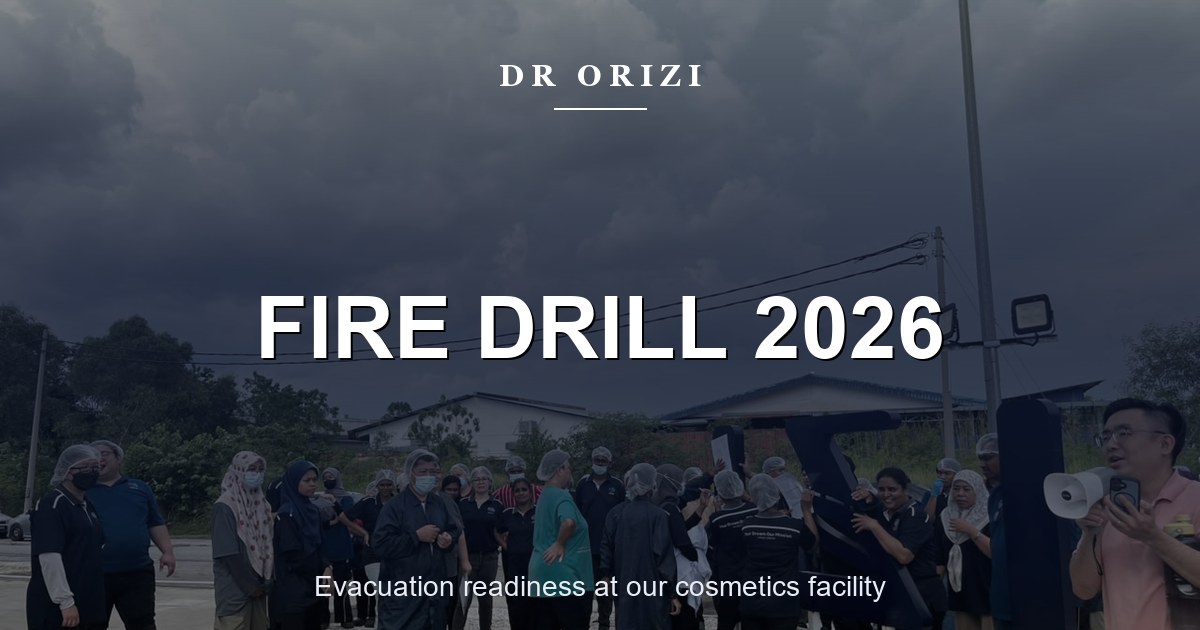
A cosmetics plant stores alcohol, volatile solvents and fragrance concentrates. That changes what a fire drill has to rehearse, and it changes what counts as a good result.
Written & researched by Edan Foo, Assistant General Manager & Manufacturing Industry Practitioner · Reviewed by Creaton Poh · Published by Dr Orizi (M) Sdn. Bhd., ORIZI Group · Last reviewed July 2026
Disclosure: This article is published by Dr Orizi and describes a company event at our own facility. External factual claims are supported by cited sources.
Quick Answer
Dr Orizi conducted a full fire drill at its Malaysian cosmetics manufacturing facility on 12 June 2026, covering emergency evacuation routes, fire alarm response, assembly point protocol and the correct actions during a fire emergency. Workplace fire safety in Malaysia is governed by the Occupational Safety and Health Act 1994 and the Fire Services Act 1988. For a cosmetics plant specifically, the drill has to account for flammable raw materials in the store, staff in gowning and hairnets who must not stop to change, and a headcount that has to reconcile against a shift list including contractors and visitors.
Key Takeaways
- The drill covered evacuation routes, alarm response, assembly point protocol and correct actions during a fire.
- Ethanol, isopropyl alcohol, fragrance concentrates and some propellants make the raw material store the highest-consequence area in a cosmetics plant.
- The measurable output of a drill is evacuation time and headcount accuracy, not attendance.
- Gowned staff evacuate as they are. An evacuation route that passes through the changing room is a design fault.
Scope of this article
This records a drill conducted at the Dr Orizi cosmetics facility in Malaysia on 12 June 2026 and explains the reasoning behind how it was run. It is a company event record. It is not a fire safety consultancy document and does not describe the specific fire protection installations at the site.
What the drill covered
- Emergency evacuation procedures — practised routes out of each production area, the warehouse, the laboratory and the offices, including secondary routes.
- Fire alarm response — what to do the moment the alarm sounds, including shutting down equipment where it is safe to do so and leaving it where it is not.
- Assembly point protocol — moving to the designated assembly point calmly and remaining there for the headcount.
- Correct actions during a fire emergency — step-by-step guidance on what to do, and equally on what not to do.
What makes a fire drill different in a cosmetics plant?
Three things that a general office evacuation does not have to consider.
1. The raw material store is the highest-consequence area
Cosmetics manufacturing routinely holds ethanol, isopropyl alcohol, fragrance and essential oil concentrates, and in some cases aerosol propellants. These are stored under their own controls, but in an evacuation their location determines which routes stay usable and which do not. A drill that never varies the assumed origin of the fire is a drill that only ever rehearses one answer.
2. Gowned staff evacuate as they are
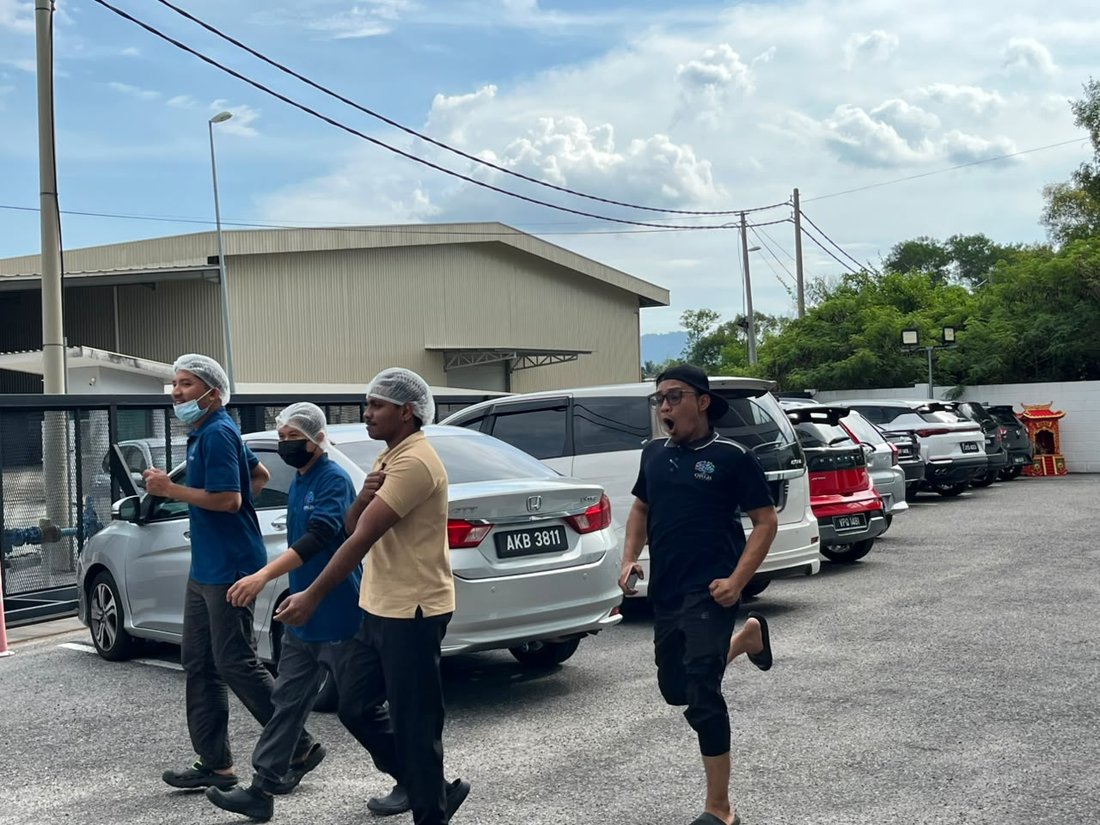
Staff in production areas wear gowns, hairnets and dedicated footwear. In an emergency they leave wearing them. This sounds obvious and is regularly got wrong, because the normal exit path from a production hall runs through the changing room by design — that is how contamination control works. The emergency route has to bypass it, and people have to have walked that route before they need it.
3. The headcount has to reconcile against a real list
A cosmetics plant on a production day contains permanent staff across shifts, contractors, drivers at the loading bay and occasionally client visitors doing a line inspection. The assembly point count is only meaningful if there is an accurate list to check it against, which makes the visitor log and the shift record part of fire safety rather than administration.
What does Malaysian law require?
Two instruments apply. The Occupational Safety and Health Act 1994 (Act 514) sets the employer’s general duty to ensure the safety, health and welfare of employees at work, enforced by the Department of Occupational Safety and Health (DOSH/JKKP). The Fire Services Act 1988 governs fire safety requirements for premises and is administered by the Fire and Rescue Department of Malaysia (Jabatan Bomba dan Penyelamat Malaysia), which is also the authority behind fire certificate requirements for designated premises.
Neither instrument reduces to a single number of drills per year for every workplace. The practical standard for a manufacturing site is at least annual, and more often where shift patterns mean that one drill does not reach the whole workforce.
The Dr Orizi perspective: what we measure
Based on our own experience running the facility, a drill where everybody walks out calmly and nothing is recorded has told you nothing. Three things are worth measuring:
- Time to full evacuation — from alarm to last person clear. This is the number that trends over successive drills.
- Headcount reconciliation — whether the assembly point count matches the shift list plus visitors, and how long it takes to establish that. An unresolved discrepancy is the finding, because in a real fire it is what sends someone back inside.
- Route behaviour — whether people used the nearest exit or the one they normally use. These are often not the same, and the gap only shows up when you watch.
A drill that surfaces a problem is a successful drill. One that surfaces nothing usually means the scenario was too easy or nobody was recording.
Limitations
- A drill rehearses evacuation. It does not test fire suppression systems, detection coverage or compartmentation, which are separately inspected and maintained.
- Announced drills measure procedure, not surprise response. Both have a place; they measure different things.
- Findings from a drill are only useful if they close. The output is a corrective action list with owners, not a photograph.
Frequently asked questions
How often should a manufacturing facility hold a fire drill?
There is no single figure that applies to every Malaysian workplace. At least annually is the common practical standard for a manufacturing site, with additional drills where shift patterns mean one exercise does not reach all staff, or after a change to the building layout.
Are cosmetics raw materials flammable?
Some are. Ethanol, isopropyl alcohol, certain fragrance and essential oil concentrates and aerosol propellants are flammable and are stored and handled under specific controls. Most finished water-based cosmetics are not.
Should staff stop to remove gowns and hairnets before evacuating?
No. Staff evacuate immediately in whatever they are wearing. The emergency route is designed so that leaving does not require passing through the changing area.
What is the difference between a fire drill and a fire safety inspection?
A drill rehearses how people respond. An inspection verifies that the building’s fire protection measures — alarms, extinguishers, hose reels, exits, signage — are present and functional. Both are needed; neither replaces the other.
Sources & references
- DOSH/JKKP — Acts — the Occupational Safety and Health Act 1994 (Act 514) referred to above.
- Jabatan Bomba dan Penyelamat Malaysia (Fire and Rescue Department of Malaysia) — the authority administering the Fire Services Act 1988 and fire certificate requirements.
Update history
July 2026 — First published, recording the fire drill held at the Dr Orizi facility on 12 June 2026.
Related from Dr Orizi: our facilities covers the production environment these procedures protect, and First Aid and CPR training covers the other half of emergency readiness. Our approach to workplace and community responsibility is set out under social responsibility. Adapted for Dr Orizi from the group announcement published by ORIZI Group.